
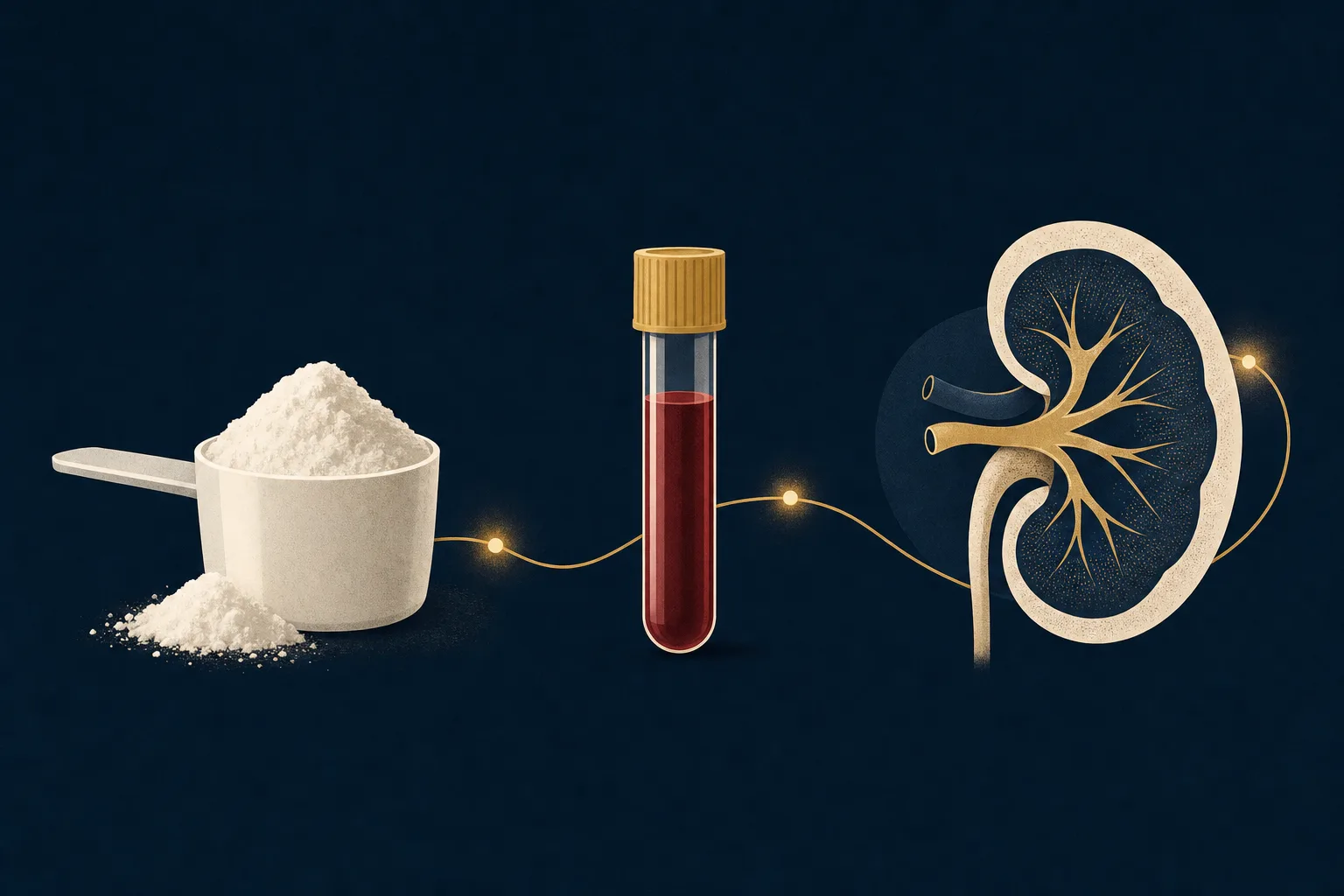
A patient in his early forties came to see me with the kind of fear you can hear before someone sits down. His routine labs had moved from a creatinine of 1.0 to 1.4 in three months. He had already read about dialysis. He had looked up life expectancy numbers. He had stopped exercising, because he assumed the workouts were what was breaking him.
Nothing in his history explained it. Blood pressure fine, no diabetes, no protein in the urine, no new prescriptions. Then I asked what supplements he was on, and he mentioned creatine. A trainer at his new gym had suggested it. Five grams a day, started right around the time the labs shifted.
We stopped the creatine, repeated the labs four weeks later, and his creatinine was back to 1.0. His kidney function had never changed at all. What changed was the test.
I have had some version of that conversation many times since, and it is why I want to walk through this slowly. Creatine is one of the most heavily studied supplements that exists, and the safety data in healthy people is genuinely reassuring. The problem is that it interferes with the exact blood test most doctors use to decide whether your kidneys are in trouble, and almost nobody warns you before the panic starts.
Why the number moves
Your body already makes creatine. Roughly a gram a day, built from three amino acids (arginine, glycine and methionine) by your liver, pancreas and kidneys working together. About 95 percent of it sits in your skeletal muscle as phosphocreatine, which is the fast-access battery your muscles pull from during anything short and hard: a sprint, a heavy set, a flight of stairs taken two at a time.
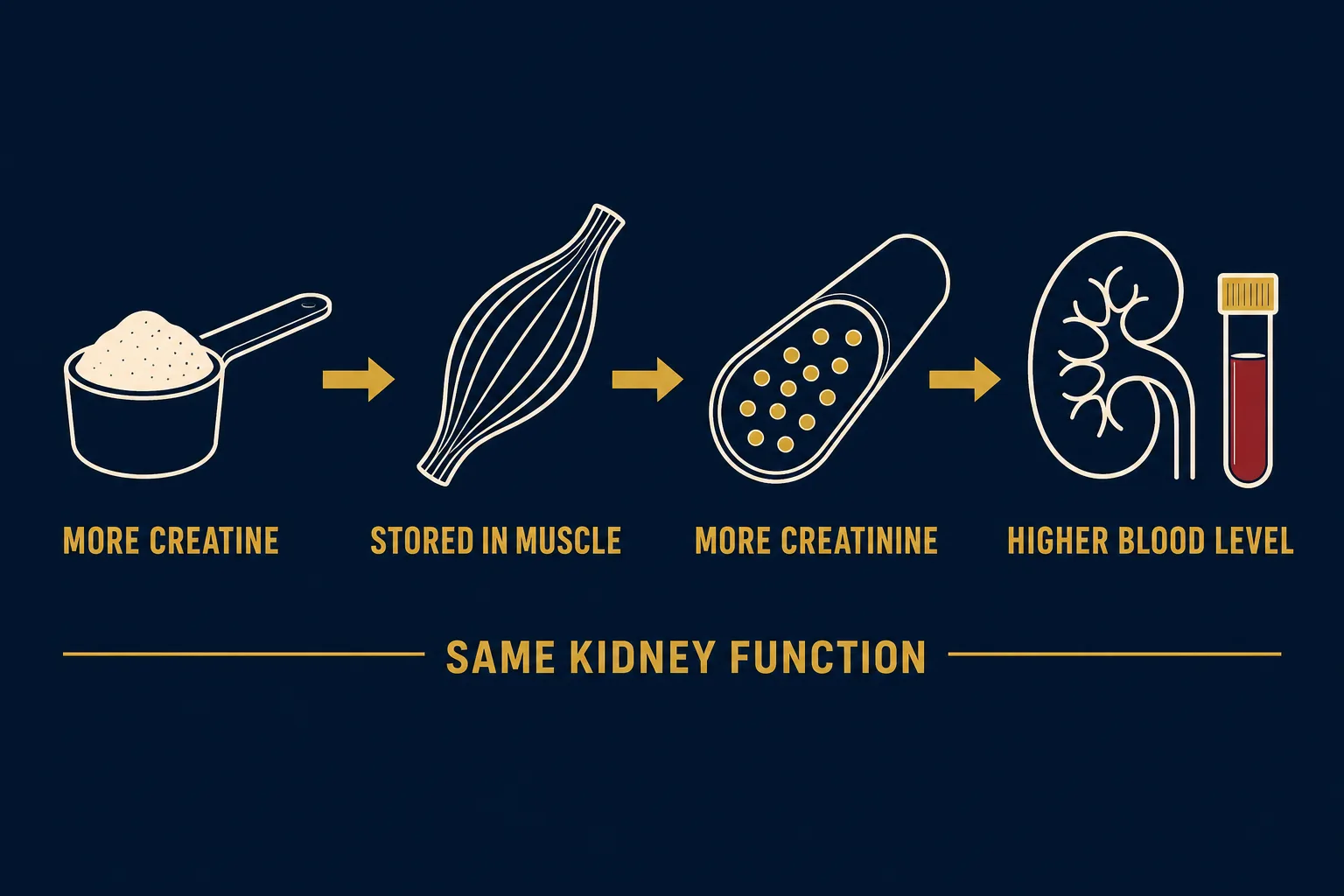
That battery does not last forever. Creatine breaks down at a fairly constant daily rate into a waste product called creatinine, and your kidneys filter that creatinine out into your urine. Which is precisely why we use it as a kidney test. If filtration slows down, creatinine backs up in the blood, and the number rises.
Now put more creatine into the system. More creatine in the muscle means more creatinine produced every day, and the blood level rises even though your kidneys are filtering exactly as well as they did last year. Your eGFR, which is calculated straight from that creatinine value, falls on paper. Nothing about the actual organ has changed.
A 2019 systematic review and meta-analysis in the Journal of Renal Nutrition looked at this across the available trials and concluded that creatine at typical doses did not produce renal damage in the populations studied (PMID 31375416). The International Society of Sports Nutrition position stand reached the same place, and the follow-up review from Antonio and colleagues addressed the kidney question head on, because it keeps coming back no matter how many times it is answered.
The cleanest way to see it is to measure kidney function a different way. Cystatin C is a small protein that every nucleated cell in your body produces at a steady rate, and the kidneys clear it the same way they clear creatinine. It is not affected by muscle mass, by how much steak you ate, or by whether you are supplementing. In people taking creatine, cystatin C based estimates stay flat while creatinine based estimates drift down. That gap is the tell.
I now order cystatin C for anyone who is supplementing and has a lab result that worries them, and for patients sitting in the grey zone where a small error changes the diagnosis. If your eGFR is hovering around 65 or 70, you are on the line between normal function and stage 2, and I do not want a supplement deciding which side of the line you land on.
The food math nobody checks
You will read, in a lot of places, that four ounces of salmon gives you the equivalent of a scoop of creatine. I want to correct that, because it is off by about a factor of ten and it leads people to some strange conclusions about their diet.
Measured in raw tissue, beef runs around 4.5 grams of creatine per kilogram. Wild salmon lands in a similar range, farmed salmon lower. Herring is the outlier at roughly 6.5 to 10 grams per kilogram, which is why it always tops these lists.
Run the arithmetic. A five gram scoop is somewhere near a full kilogram of beef, or a bit over half a kilogram of herring, eaten in one day. Not four ounces. Nobody is hitting supplement doses through dinner, and any article telling you otherwise has not done the multiplication.
That does not make food pointless. It just means food gives you maintenance, not loading. Two servings of oily fish a week keeps your baseline where it should be and brings along omega-3s, which have their own quiet benefits for blood pressure and vascular inflammation. It also explains why vegetarians and vegans, who take in essentially no dietary creatine, start with muscle stores about 20 to 30 percent lower and tend to notice supplementation more than lifelong meat eaters do. There is more room to fill.
One small practical note: creatine is water soluble, so boiling meat leaches a meaningful fraction of it into the pot. If you stew or boil, use the liquid.
What the research actually supports
I do not want any of this to read as an argument against creatine. The performance data has held up for three decades, which is rare for a supplement. Strength and power output in resistance training improve on the order of five to fifteen percent, recovery between hard sets is better, and time to fatigue during repeated high intensity efforts stretches out.
The more interesting work right now is outside the gym. There is a growing literature on age related muscle loss, where creatine combined with resistance training appears to help older adults hold onto strength and function. That one gets my attention as a kidney doctor, because muscle wasting in advanced kidney disease is one of the strongest predictors of how somebody does. There is early work on cognition, on mood, on recovery from brain injury. Most of it is preliminary and I treat it that way, but it is real research and not marketing.
Who should slow down before starting
If your kidneys are healthy, three to five grams a day is a reasonable thing to take, and I say that as someone whose entire practice is kidney disease.
The picture is different if you already have chronic kidney disease at stage 2 or beyond, if you are diabetic, if your blood pressure runs high, or if you have protein showing up in your urine. Not because we have evidence that creatine harms those kidneys, but because we mostly do not have evidence either way. The safety trials were run in healthy young people and in athletes. Extrapolating from a 25 year old with perfect filtration to a 60 year old with an eGFR of 42 and albuminuria is not something I am willing to do casually.
A family history of kidney disease belongs in the same conversation, even when your current numbers look fine. Some of what runs in families does not show itself until there is stress on the system.
None of that makes creatine off limits. It moves it into the category of things you do with your doctor watching, not on a trainer's recommendation. And if you are already on medications that lean on the kidneys, whether that is regular NSAIDs, certain antibiotics, or diuretics, that is another reason to have the conversation before rather than after.
How I set it up when a patient does take it
Get baseline labs first, and get them before the first scoop rather than after. Without a starting point, every future result is a guess.
Tell whoever draws your blood, and tell whoever reads it. This one sentence in your chart prevents most of the trouble I see. A creatinine of 1.3 in a person who supplements means something completely different from a creatinine of 1.3 in a person who does not, and your doctor cannot know unless you say so.
Skip the loading protocol. The old twenty grams a day for a week routine mostly buys you stomach upset and a faster arrival at the same destination. Three to five grams daily saturates muscle over three or four weeks with far fewer complaints.
Buy plain creatine monohydrate that has been third party tested. Look for NSF Certified for Sport, Informed Choice or USP Verified on the label. Supplements are regulated loosely enough that contamination with heavy metals is a genuine concern, and when your kidneys are the organ that has to clear those metals, this is not a place to save eight dollars. The exotic forms (ethyl ester, buffered, liquid) cost more and have never outperformed monohydrate in a head to head trial.
Expect two to four pounds of weight gain in the first couple of weeks. It is water pulled into muscle cells, not fat, and it settles.
And keep the proportions right. I have patients who take fifteen supplements and still have an A1c of 8.4 and a blood pressure of 150 over 95. Creatine will not touch either of those. Blood sugar control, blood pressure control, sleep, and staying off chronic NSAIDs do more for your kidneys than anything you can buy in a tub.
Frequently asked questions
Does creatine damage your kidneys? In people with healthy kidney function, the available trials and meta-analyses have not shown kidney damage at typical doses of three to five grams a day. What creatine reliably does is raise serum creatinine, which makes a creatinine based eGFR look worse without any change in actual filtration. In people who already have kidney disease the long term data is thin, which is why that group should only supplement under medical supervision.
Why did my creatinine go up after starting creatine? Because more creatine in your muscle means more creatinine produced and released into your blood every day. Your kidneys are clearing it at the same rate as before, but they are clearing more of it, so the blood level sits higher. This typically shows up within a few weeks of starting and reverses within roughly four weeks of stopping.
How long should I stop creatine before a kidney blood test? There is no single validated washout period, but in my practice roughly four weeks off is usually enough to see the number return to a person's true baseline. The better option in most cases is not stopping at all, but asking for a cystatin C based eGFR instead, since it is not influenced by creatine.
Is cystatin C better than creatinine for people who supplement? For this specific question, yes. Cystatin C is produced by cells at a steady rate and is not affected by creatine intake, muscle mass or diet. It costs more and is not ordered routinely, which is the main reason creatinine remains the default test. If you supplement and your creatinine result is in question, cystatin C is the test to ask for.
Can I take creatine if I have stage 3 chronic kidney disease? That is a decision to make with your nephrologist, not from an article. The honest position is that we lack good long term trials in CKD, so we are reasoning from limited data. Some patients with sarcopenia and muscle loss may have more to gain than to lose, but it requires baseline labs, a clear monitoring plan, and a test that creatine does not distort.
Does creatine cause dehydration, cramping or hair loss? The cramping and dehydration concerns have been examined repeatedly and have not held up in controlled trials. The hair loss question traces back to a single small study in rugby players showing a rise in DHT, which has not been replicated as hair loss in later work. I would not counsel someone away from creatine on those grounds.
How much creatine is in food, really? Around 4.5 grams per kilogram of raw beef, a similar figure for wild salmon, and 6.5 to 10 grams per kilogram for herring. A five gram supplement dose is close to a kilogram of beef in a single day. Food maintains your stores. It does not load them.
The part I care about most
Kidney disease is quiet. It does not hurt, it rarely announces itself, and by the time most people find out, a meaningful amount of function is already gone. So I understand completely why a rising creatinine sends someone into a spiral, and I would rather a patient overreact to a lab result than ignore one.
But fear makes for terrible medicine when the fear is aimed at the wrong thing. The man in my office had spent three months losing sleep over a number that his supplement had moved. He had also stopped exercising, which was the single worst thing he could have done for the organs he was trying to protect.
Ask what the test is measuring. Ask whether anything you are taking changes what it measures. And if you have any reason to think your kidneys are not in perfect shape, get that established properly first, with the right test, before you add anything at all.
This article is for education and is not medical advice. Doses, supplements and lab interpretation should be discussed with your own physician, particularly if you have chronic kidney disease, diabetes or high blood pressure.