Kidney Holistic Institute · Precision Nephrology™
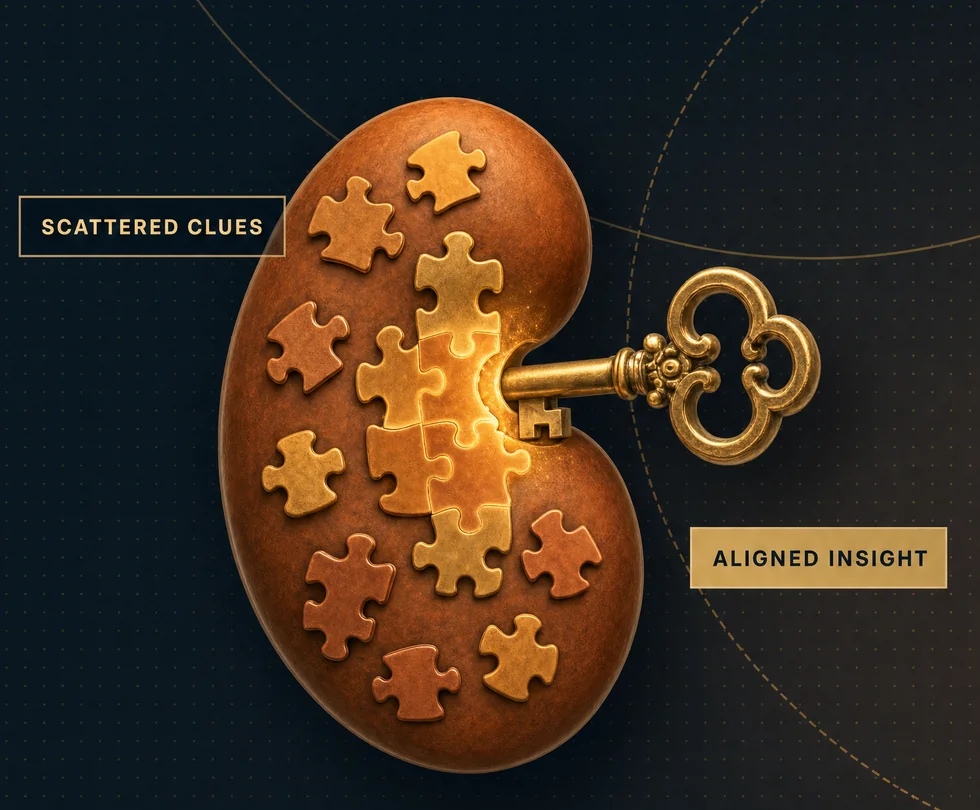
Your kidneys aren’t failing. They’re signaling. Kidney Key, our whole-genome kidney profile, is how we read what they’re actually saying.
People can have the same lab result and be dealing with completely different problems: one inherited, one driven by inflammation or toxins, one arising from how their body processes hormones and nutrients. Kidney Key exists to tell those stories apart.
Three things that happen during a whole system nephrogenomic profile testing. One, a saliva or cheek swab at home. No blood draw, no needle. Two, that sample goes to the lab. Three, once they're in, we sit down together and go through them in plain language. No genetic names, no jargon, just what your tendencies actually mean for your care. That's it. All the complexity lives on the lab and analysis side. The experience you get is about as simple as testing gets.
One Test. Two Answers.
Each report has a distinct purpose, so a functional finding is never mistaken for a diagnosis, and no result is taken out of context.
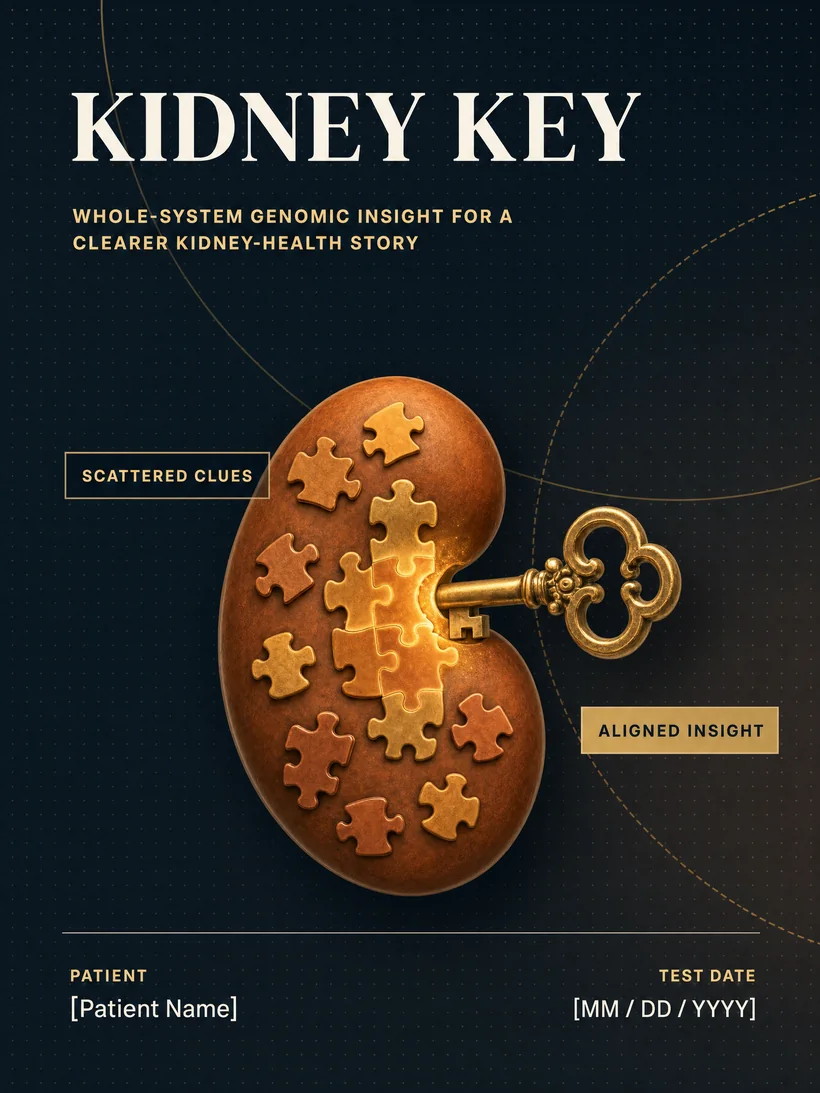
Kidney Key is documented on your consent form and lab report as the Whole-System Nephrogenomic Profile™.
Is there an inherited cause?
Whole-genome sequencing reads your entire genome, then checks it against ClinVar, the public catalogue of variants known to cause disease: more than 300,000 pathogenic and likely-pathogenic variants across 15,000+ genes and 11,000+ conditions. It is a full scan, not a fixed kidney gene list:
A finding here can change the direction of care, clarify a diagnosis that has been uncertain, or reveal something worth discussing with family. This report is performed and clinically reported by the sequencing laboratory.
How is your system working, and what does it need?
Most kidney decline is not a single-gene story. It emerges from how your whole system handles pressure, inflammation, oxidative stress, detoxification, nutrients, hormones and blood sugar over years. 132 gene variants and polygenic scores are organized into sixteen focused areas, from the renal core itself to the systems upstream of it.
Select any area in the map below to see what it covers, from blood pressure and blood sugar to methylation, detox capacity, the gut, hormones, stress and sleep.
These findings are tendencies, not verdicts, and not a diagnosis. They tell us where your system is likely working harder than it should be, which is precisely where change makes the most difference.
Follow the Clues
The functional report is organized into sixteen focused areas. Select a tile to see the markers held within that part of the broader whole-system picture.
What We Do With It
The functional report is organized around the HEAL Protocol, so what we learn translates directly into what we do.

The Process
A saliva or cheek swab, no blood draw. Your kit includes what you need.
Both reports are prepared and quality-checked before they are reviewed.
In a dedicated consultation, your results are explained in plain language and considered with your full clinical picture.
Important Context
Your DNA holds roughly 25,000 genes across three billion units of code. Small variations shape how your body makes hormones, handles inflammation, clears toxins and uses nutrients. These are not defects, they are the specific way your system is built, and most of what they describe can be worked with.
Small variations can shape how the body makes hormones, handles inflammation, clears toxins, and uses nutrients. Kidney Key can help point the discussion toward places worth examining more closely.
These results do not predict a fixed future or replace your history, symptoms, laboratory data, and clinical evaluation. Functional findings are tendencies, not verdicts, and not a diagnosis.
Genetic findings are always interpreted in the context of your full clinical picture. No treatment or medication is ever started, stopped, or changed based on genomic results alone.
Before any testing, we walk you through a full consent that covers exactly what the analysis includes and how your results are handled, so nothing is ever a surprise.
The number one misconception about what a genomic profile can and can't tell you. So, a genetic finding is a diagnosis or a guaranteed future? That's the biggest misconception because it's not. What genomic testing shows are tendencies. A leaning in one direction or another, not a prediction of what will definitely happen to you. Having a genetic tendency doesn't mean you're destined for a particular outcome. Not having it doesn't mean you're in the clear either. Genes load the gun. But lifestyle, environment and the choices we make together in your care plan have enormous influence over what actually happens. That's all actually called epigenetics. Tendency, not verdict. That distinction matters every single time.
An Introduction
“A number tells you where you are. The right questions help explain why.”
Inherited findings and functional findings answer different questions and should not be read as the same kind of result.
Use the sections to identify areas that may deserve a closer conversation in the context of your own health.
Your report is designed to be interpreted with your clinical picture, not in isolation.
How to Get Kidney Key
Kidney Key is part of our one-on-one program. If you are not there yet, the 28-day program is the place to start.
The full whole-system program with comprehensive testing, detoxification, the compounding pharmacy, and up to 20 days at our Houston clinic. Available where Dr. Bismah is licensed, or fly in to Houston.
Daily lessons taught by Dr. Bismah Irfan, MD, a supportive community and a clear place to begin. Join any day; your Fast-Start opens immediately. See the program →
Begin with a Clearer Question
We will walk you through the testing, the consent, and the right way to use the information in your care.
See if Kidney Key is right for youTell us a little about your situation. Our clinical advisor will reach out to walk you through the testing, the consent, and the right way to use the information in your care. Or call us at 281-394-0238.
One last step: pick a time below and our team will call you then. Prefer to wait for us to reach out? That works too, or call 281-394-0238.