
Quick answer: yes, dialysis can be temporary. When the kidneys stop working suddenly, for example after severe dehydration, a serious infection, a blocked urinary tract or a reaction to a medication, dialysis can do their job while they recover. In a large US registry study of people whose kidney failure was caused by a sudden kidney injury, about 1 in 4 had recovered enough to stop dialysis within three months, and about 1 in 3 within a year. When kidney failure builds slowly over years from chronic kidney disease, dialysis is usually long-term: across everyone who starts outpatient dialysis in the US, about 4 in 100 recover enough function to stop within a year.
Below: what temporary dialysis looks like, how long it usually lasts, and how the care team decides when it can end.
Temporary vs. long-term dialysis at a glance
Swipe the table sideways to see both columns.
| Temporary (acute) dialysis | Long-term (maintenance) dialysis | |
|---|---|---|
| Why it starts | A sudden kidney injury, often in the hospital | Chronic kidney disease that has reached kidney failure |
| Where | Hospital or ICU first, sometimes continued at an outpatient dialysis center | Outpatient center or at home |
| Access | A temporary catheter in a large vein in the neck or groin; a tunneled catheter if it runs longer | A fistula, graft or tunneled catheter; a PD catheter for home dialysis |
| How long | Days to weeks, sometimes a few months | Years, or until a kidney transplant |
| Goal | Keep the body stable until the kidneys recover | Replace kidney function over the long term |
What usually causes dialysis to be temporary
Temporary dialysis almost always follows acute kidney injury, a sudden drop in kidney function over hours or days. The common causes are:
- too little blood reaching the kidneys: severe dehydration, heavy blood loss, very low blood pressure, heart failure or sepsis;
- direct damage: some antibiotics, high doses of anti-inflammatory painkillers (NSAIDs), contrast dye, or muscle breakdown after an injury or extreme exercise;
- a blockage that keeps urine from leaving: an enlarged prostate, kidney stones or a tumor;
- inflammation inside the kidneys, as in some forms of glomerulonephritis or lupus nephritis;
- certain poisonings, where dialysis also clears the toxin from the blood.
Most people with acute kidney injury never need dialysis. It is used when the kidneys can't keep potassium, fluid or acid in a safe range, or when waste buildup starts to cause symptoms such as confusion or severe nausea.
What temporary dialysis is like
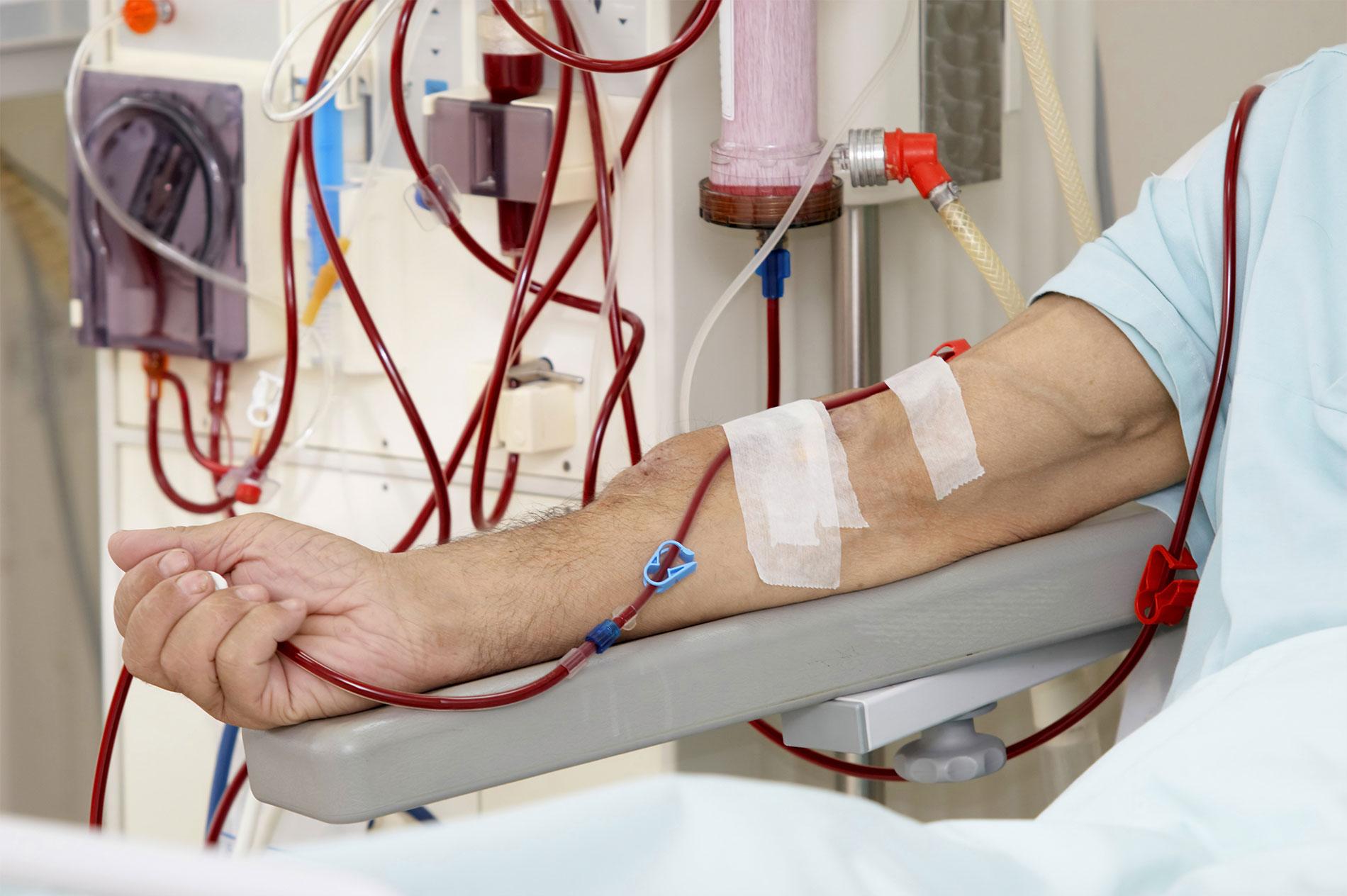
In the hospital, temporary dialysis is usually hemodialysis through a catheter placed in a large vein in the neck or groin. The catheter is put in at the bedside with numbing medicine. People in intensive care who are too unstable for a regular session may get continuous dialysis (CRRT), which runs slowly around the clock.
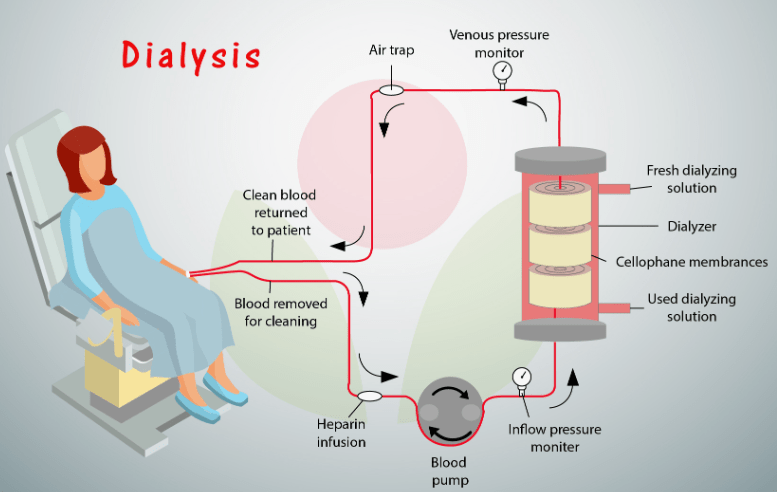
A non-tunneled catheter is meant for short-term use, generally under two weeks, because the infection risk rises the longer it stays in. If dialysis is likely to go on longer, the team switches to a tunneled catheter, which sits under the skin and is safer for weeks or months.
You don't have to stay in the hospital until your kidneys recover. Since 2017 Medicare has covered dialysis for acute kidney injury at outpatient dialysis centers, so many people continue their sessions close to home while the team watches for recovery.
How long can you be on temporary dialysis?
There is no fixed limit. Most people who recover do so within the first three months. In one US hospital study of people who went home on dialysis after a sudden kidney injury, 41% recovered within 90 days, and more than half of them did so within 30 days of leaving the hospital. A smaller group recovers later: in the registry study above, the share off dialysis kept rising from about 1 in 4 at three months to about 1 in 3 at one year.
If the kidneys haven't picked up after about three months, doctors usually treat the condition as chronic, and the conversation turns to long-term dialysis, home dialysis options or a transplant evaluation. Even then, recovery is reviewed again if your labs or urine output change.
Signs the kidneys may be recovering
Recovery usually shows up in the numbers before you feel it. The care team looks for:
- more urine each day;
- creatinine and BUN that stay steady or fall between sessions instead of climbing;
- potassium and fluid that stay in a safe range with less dialysis.
When these hold, dialysis is cut back and then stopped. In the meantime the team tries to protect the recovering kidneys by avoiding drops in blood pressure during dialysis and medicines that strain them.
Please don't skip or stop dialysis on your own, even if you feel better. Feeling well and having safe potassium and fluid levels are not the same thing, and the decision to stop is made from your labs.
Can dialysis be temporary in chronic kidney disease?
Usually not. When kidney function has declined over years, dialysis is generally long-term unless you receive a transplant. Across everyone who starts outpatient dialysis in the US, about 4 in 100 adults recover enough function to stop within a year (4.5% in a second registry study). Recovery is most common when the cause was a sudden injury, such as acute tubular necrosis or acute interstitial nephritis, and much less common after years of slow decline.
Your nephrologist will keep checking how much function your kidneys have left and treat what still affects them, such as blood pressure, blood sugar and medications. More on long-term care is in chronic kidney disease treatment.
After temporary dialysis
Coming off dialysis is not the end of follow-up. An episode of acute kidney injury raises the chance of chronic kidney disease later, so kidney function should be checked again about three months afterward, and regularly after that. Keep track of your blood pressure, ask before taking NSAIDs, and tell every new doctor that you had kidney injury requiring dialysis. For what recovery usually looks like week by week, see how long acute kidney injury takes to recover.
Hemodialysis or peritoneal dialysis?
Temporary dialysis in the hospital is almost always hemodialysis or CRRT. If dialysis turns out to be long-term, there are two main options: in-center hemodialysis, usually three sessions a week of about four hours each (about 12 hours a week), or peritoneal dialysis at home, often overnight. For a side-by-side comparison, see types of dialysis and how they differ, and for the long view, how long a person can live on dialysis.
Living with dialysis while you wait
While you are on dialysis, a renal dietitian will usually ask you to watch fluid, salt, potassium and phosphorus and still eat enough protein; the potassium chart for meats and fish helps with the protein part. Gentle activity such as walking, cleared with your care team, helps with strength and mood, and so does talking openly with family and the dialysis staff about how you are coping.
Frequently Asked Questions
Can dialysis be temporary?
Yes. When dialysis starts because of a sudden kidney injury, it is often temporary and stops once the kidneys recover enough to keep potassium, fluid and waste in a safe range. When it starts because chronic kidney disease has reached kidney failure, it is usually long-term unless you get a transplant.
How long can you be on temporary dialysis?
There is no set limit. Most people who recover come off dialysis within the first three months, many in the first few weeks after leaving the hospital. If there is no recovery after about three months, doctors usually consider the kidney failure chronic and plan long-term treatment, while still watching for late recovery.
What is temporary dialysis called?
Doctors may call it acute dialysis, dialysis for acute kidney injury (AKI-D) or acute kidney replacement therapy. In intensive care it is often continuous renal replacement therapy, or CRRT, which runs slowly around the clock.
Can you get off dialysis once you start?
Yes, if the kidneys recover. In US registry data on people whose kidney failure came from a sudden kidney injury, about 1 in 4 had stopped dialysis within three months and about 1 in 3 within a year. When dialysis starts for long-standing chronic kidney disease, recovery is far less common; across all new outpatient dialysis patients it is about 4 in 100.
Is temporary dialysis safe?
It is a routine hospital treatment, but it has risks: infection or bleeding at the catheter, drops in blood pressure, cramps and tiredness after sessions. Most serious risks come from the illness that caused the kidney injury, not from dialysis itself.
Is temporary dialysis painful?
The catheter is placed with numbing medicine, so you feel pressure more than pain. The sessions themselves don't hurt, though some people get cramps, headaches or feel drained afterward. Tell the nurse right away if you feel dizzy or crampy.
Does high creatinine alone mean you need dialysis?
No. Doctors start dialysis based on what the kidney failure is doing to the body: dangerous potassium levels, fluid in the lungs, acid buildup, or symptoms from waste buildup. A high creatinine number is part of the picture, not the trigger on its own.
Can your kidneys start working again after dialysis?
Dialysis doesn't restart the kidneys. It keeps you stable while they recover on their own, if the injury allows it. Your team watches your urine output and labs between sessions to see whether they are picking back up.
Sources
- Shah S, et al. A clinical score to predict recovery in end-stage kidney disease due to acute kidney injury. Clin Kidney J. 2024;17(5). US Renal Data System, 2005-2014, n=22,922. PMC11079670
- Ku E, et al. Recovery of kidney function after dialysis initiation in children and adults in the US: a retrospective study of United States Renal Data System data. PLoS Med. 2021. PMC7935284
- Santos M, et al. Predictors of kidney function recovery among incident ESRD patients. BMC Nephrol. 2021. PMC8059163
- Kidney recovery in patients with acute kidney injury treated in outpatient hemodialysis or rehabilitation facilities. Kidney Med. 2021;3(6):916-924. DOAJ
- Vijayan A, et al. ASN Kidney Health Guidance on the outpatient management of patients with dialysis-requiring acute kidney injury. J Am Soc Nephrol. 2025. ASN release
- KDIGO Clinical Practice Guideline for Acute Kidney Injury. Kidney Int Suppl. 2012;2(1).
- KDOQI Clinical Practice Guideline for Vascular Access: 2019 Update. Am J Kidney Dis. 2020;75(4 Suppl 2).
- National Institute of Diabetes and Digestive and Kidney Diseases. Hemodialysis. niddk.nih.gov